
Axis Bank on Thursday reported a 54 per cent jump in its standalone net profit to Rs 4,117.77 crore for the quarter ended March 2022. The country's third-largest private sector lender had posted a net profit of Rs 2,677.06 crore in the year-ago period. The total income (standalone) rose to Rs 21,999.58 crore in the January-March period of 2021-22 against Rs 19,035.12 crore in the same period of 2020-21, Axis Bank said in a regulatory filing. For the full 2021-22, the net profit nearly doubled to Rs 13,025.48 crore from Rs 6,588.50 crore in 2020-21.

Among the Sensex firms, ITC, Kotak Mahindra Bank, ICICI Bank, Nestle, Axis Bank, IndusInd Bank, UltraTech Cement, Bajaj Finance, Maruti and HDFC Bank were the major laggards.

Infosys on Thursday posted a 7.8 per cent year-on-year rise in consolidated net profit at Rs 6,128 crore in March quarter of FY23, and gave 4-7 per cent revenue growth forecast for FY24 amid macro economic uncertainities. The net profit (after minority interest) stood at Rs 5,686 crore in the fourth quarter of FY22. Seen sequentially, the net profit for Q4 came in 7 per cent lower.

Household indebtedness is higher in the southern states as compared to the other parts of the country, a report said on Tuesday. Citing the All India Debt and Investment Survey (AIDIS) data from 2013-2019, domestic agency India Ratings said household indebtedness both in rural and urban areas was higher in southern states than rest of India. In 2019, Telangana with 67.2 per cent had the highest proportion of its rural households indebted and Nagaland with 6.6 per cent had the lowest proportion of its rural households indebted.

The country's second-largest IT services firm Infosys on Wednesday reported a 16.6 per cent rise in consolidated net profit at Rs 5,197 crore for the December 2020 quarter. The company had posted a net profit (after minority interest) of Rs 4,457 crore in the year-ago period, Infosys said in a regulatory filing. Its revenue grew 12.3 per cent to Rs 25,927 crore in the quarter under review from Rs 23,092 crore in the corresponding period last fiscal.

Hindalco has already bagged 4 mines in Jharkhand and Chhattisgarh

Index heavyweights Reliance Industries, HDFC and Infosys were the top Sensex gainers.

India Inc did not perform well during December quarter.

In addition to the negative sentiment as a consequence of changes announced in the Union Budget 2023-24 concerning tax treatment for debt repayment distribution, concerns about hiring slowdown and its leasing impact, as well as higher interest rates, could blight the sector in the near term.

India's top listed companies reported their best-ever quarterly net profit of Rs 2.39 trillion in the September quarter of FY22, up 46.4 per cent year-on-year. The earnings were driven by a big surge in the profitability of banks, non-banking financial companies & insurance (BFSI), oil & gas, and metal & mining firms. The combined net profit of these three cyclical sectors were up 87 per cent YoY to a record high of Rs 1.53 trillion, up from Rs 82,000 crore a year ago and Rs 1.08 trillion in Q1FY22.

The recent surge in crude oil prices could shave off the gains made by India Inc in profit margins in the past few quarters. Worse, it comes at a time when consumer demand in the country is slipping and major global economies are witnessing a slowdown. A back-of-the-envelope calculation suggests that the margin expansion accounted for three-fourths of the rise in the listed firms' operating profit between the April-June quarter (Q1) of FY23 and Q1FY24, and only a quarter of profits gains came from revenue growth.

Hospitals to recover from sluggish Q3; diagnostics' growth rate at pre-Covid levels.

'The global situation is not very good.'

India's GDP may turn positive at 1.3 per cent in the third quarter of 2020-21, having witnessed contraction in the previous two quarters due to the coronavirus pandemic, as the number of cases is falling and public spending has started rising, according to a report. The government will release the GDP numbers for the October-December quarter of the current fiscal on Friday. Projecting that the gross domestic product (GDP) may have returned to the black in the last quarter of the calendar year 2020, DBS Bank in the report said the full-year growth in real terms may be at a negative 6.8 per cent.

Tata group companies have outperformed the broader market over the past four years, under the chairmanship of N Chandrasekaran. However, the group's fortunes rely heavily on the performance of Tata Consultancy Services (TCS) now, as compared to the past. The combined market capitalisation of the group's listed companies has nearly doubled in the last four years, against a 77 per cent rally in the benchmark Sensex during the period. The overall market value of 16 key group firms - excluding listed subsidiaries of such entities - stood at Rs 16.8 trillion as of Friday. This was close to 2x the Rs 8.45 trillion as of February 21, 2017 - the day Chandrasekaran took charge as chairman of Tata Sons.

This is a good opportunity for long-term investors to pick quality small and midcap stocks at reasonable valuations.

Brokerages have cut their estimates of listed diagnostics players for the financial year 2023-24 (FY24) after mixed December quarter results and muted near-term outlook. Their volumes and realisations will be under pressure due to weakness in Covid-adjusted performance and higher competitive pressures, the brokerages believe. In a post-Q3 results note on Dr Lal Pathlabs, Bhavesh Gandhi of YES Securities pointed out that there has been a lack of volume revival in recent quarters, with an increasing likelihood that FY24 too would be a work-in-progress year for the company's initiatives to bear fruit.
Banks enjoyed an expansion in Net Interest Margins (or NIMs) as well as in credit demand through the 2022-23 financial year (FY23). The credit expansion was because economic growth continued to recover from the Covid-19 years, and indeed, second half GDP growth surprised on the upside. The NIM expansion was because banks raised lending rates immediately (in many cases automatically due to floaters) as the Reserve Bank of India (RBI) hiked policy rates, and only started raising deposit rates late into the fiscal.

This period of strong growth not only offers opportunities but also calls for strategic considerations to ensure sustainable development and equitable prosperity in the years to come, suggests Sujan Hajra.
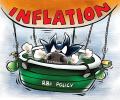
The Reserve Bank of India on Friday raised the retail inflation target for the current financial year to 5.7 per cent on the back of rising global prices amidst the ongoing geo-political tensions, even as it expected the prices of cereals and pulses to soften on prospects of good winter crop harvest. "Global food prices along with metal prices have hardened significantly. "Economy is grappling with a sharp rise in inflation... Inflation is now projected at 5.7 per cent in 2022-23 with Q1 at 6.3 per cent; Q2 at 5 per cent; Q3 at 5.4 per cent and Q4 at 5.1 per cent," RBI Governor Shaktikanta Das said while unveiling the first monetary policy review for the current fiscal year.

Citing a weak manufacturing sector coupled with the steep margin compression, SBI Research has pencilled in the country's GDP growth for the second quarter at 5.8 per cent, down 30 basis points from average estimates. The government will release the official numbers on November 30. In a report on Monday, SBI Research headed by Soumya Kanti Ghosh said corporate results, operating profit of companies, excluding banking and financial sector, degrew by 14 per cent in Q2FY23 as against 35 per cent growth in Q2FY22, though the top line continued to grow at a healthier pace.

Marking its quickest rise in over seven years, India's services sector activity expanded for the fifth successive month in February, tracking spike in business orders, renewed export demand and strengthening business confidence, a monthly survey showed on Wednesday. The IHS Markit India Services Business Activity Index rose from 55.5 in January to 57.5 in February. This is the fastest expansion in services output since January 2013.

Shares of Yes Bank may face selling pressure as the Reserve Bank-mandated three-year lock-in period for individual investors and exchange-traded funds is ending on Monday, according to analysts. The analysts expect distress on the bank counter on Monday as they expect investors, primarily the nine banks led by State Bank, which picked up almost 49 per cent of its stocks in March 2020 for Rs 10 per share -- at a premium of Rs 8 on the face value as part of the RBI bailout, making an exit. Exchange-traded funds are also likely to press the exit button.

Buoyancy in the real estate sector along with improved construction activities created jobs and facilitated the return of migrant workers to cities, the Economic Survey for 2022-23 tabled in Parliament on Tuesday said. This assumes significance in view of loss of jobs due to lockdown restrictions imposed in various parts of the country from time to time amid different waves of pandemic since March 2020. The survey points towards sustained recovery in the economic activities during 2022-23 fiscal year.

The country's largest lender SBI on Thursday reported a 4.20 per cent decline in consolidated December quarter net at Rs 6,257.55 crore, largely because of a higher base in the year-ago period where it had benefitted from a Rs 4,500 crore one-off income. On a standalone basis, the city-headquartered lender's net profit came in at Rs 5,196.22 crore as against Rs 5,583.36 crore in the year-ago period and Rs 4,574.16 crore in the preceding September quarter. SBI chairman Dinesh Kumar Khara told reporters that the year-ago period had seen the resolution of the Essar Steel loans, resulting in an over Rs 4,000 crore interest income and Rs 500 crore other income benefit.

Corporate revenues will decline for a third consecutive quarter in March on a YoY basis - one of the worst shows by these companies in many years.

Markets in green tracking firm global cues.

Wall Street brokerage Goldman Sachs has lowered its estimate for India's economic growth to 11.1 per cent in fiscal year to March 31, 2022, as a number of cities and states announced lockdowns of varying intensities to check spread of coronavirus infections. India is suffering the world's worst outbreak of COVID-19 cases, with deaths crossing 2.22 lakh and new cases above 3.5 lakh daily. This has led to demand for imposition of nationwide strict lockdowns to stem the spread of the virus - a move that the Modi government has so far avoided after the economic devastation last year from a similar strategy.

Commercial banks in the country continued with their improving asset quality trend in the October-December 2021 quarter with slippages remaining under control coupled with healthy recoveries and upgradation of asset classification. The 28-listed banks reported improvement in bottom line with net profits rising 64.1 per cent year-on-year (YoY) and 21.5 per cent sequentially. This is mostly on account of a fall in provisions and contingencies.

India's current account deficit narrowed to $1.3 billion or 0.2 per cent of GDP in the January-March quarter of FY23, mainly due to moderation in the trade deficit and a robust increase in services exports, RBI data showed on Tuesday. However, for the 2022-23 fiscal, the current account balance recorded a deficit of 2 per cent of GDP compared to 1.2 per cent in 2021-22. "India's current account deficit (CAD) decreased to $1.3 billion (0.2 per cent of GDP) in Q4:2022-23 from $16.8 billion (2.0 per cent of GDP) in Q3:2022-231, and $13.4 billion (1.6 per cent of GDP) a year ago [Q4:2021-22]," as per the RBI's 'Developments in India's Balance of Payments during the Fourth Quarter (January-March) of 2022-23'.

The trend in corporate earnings suggests that index earnings could fall to the levels last seen in early 2014.

Jhunjhunwala holds a stake in more than 30 listed firms.

Tata Steel has a very British problem. The performance of Europe dragged the steel major's October-December (Q3FY23) performance with the UK business accounting for a major part of the operating loss; on the bottom line, the overhang of the British Steel Pension Scheme (BSPS) showed. And a nearly three-year discussion with the UK government on a support package for a green transition resulted in an offer that fell short of the ask.

Check out some of the stocks that will react on the basis of their numbers in the near term.

The highlights of the RBI's fourth monetary policy review of fiscal year 2022-23 announced by Governor Shaktikanta Das.

While the positive surprise has been the high growth in agriculture, the negative surprise is in the trade, transport, hotels segment where growth came lower than expected, says Madan Sabnavis.

Bajaj Finance's quarterly business update, coupled with around 24 per cent fall over the past six months, has turned risk-reward favourable for investors, observe analysts. They see up to 39 per cent upside in the stock, from a one-year perspective. Global brokerage CLSA, for instance, has upgraded the stock from 'underperform' to 'outperform' with an increased one-year target price of Rs 6,600 (vs Rs 6,000 earlier) as it believes the risk-reward has turned favourable for the counter, and there is scope for expansion if growth remains robust.

The Bengaluru-based company had registered a net profit (after minority interest) of Rs 5,197 crore a year ago, a regulatory filing said. Infosys' revenue grew 22.9 per cent to Rs 31,867 crore in the quarter ended December 2021 from Rs 25,927 crore in the year-ago period, it added.

After startups and Big Tech, the layoff season may have begun at the $245 billion Indian information-technology (IT) industry. Bengaluru-based IT major Wipro is looking to cut hundreds of jobs, targeting mid-level employees working onsite as the company looks to improve margins, according to a media report, citing two sources. The company has said it is aligning its business and talent to the changing market environment.

Shares of Tata Consultancy Services on Wednesday plunged almost 4 per cent, wiping out about Rs 16,000 crore (Rs 160 billion) in investor wealth, after the IT major indicated to analysts that weak India business and lower working days could drag down March quarter growth rate.
 © 2026 Rediff.com - Advertise with us - Disclaimer - Privacy Policy - Sitemap - Feedback - About us - Terms of use - Grievances